


Look at that: we’re back already, only a week late! I hope you had a reasonable April. This edition is going to be fairly short, as we want to introduce two massive updates to the platform. Very happily, we’re bringing you words from two of us today.
As always, let’s first listen to what has been happening on the map over the last few weeks.
AudioSpace(s) of the month
I was recently afflicted again with the being-in-England illness, and I’m starting to resign myself to the fact that it might be chronic. A visit to Reference Point in London, however, was all I needed to remind me of one thing I do love about this cursed island: everywhere you go, there are interesting things being done with sound.
Echoing those drones and modular bloops we heard – which you can here in oliver and seb sw’s contributions – melodies and musical timbres from around the world was a major theme on the map this past month.
Musical sounds by humans and nonhumans, machines and geological forces.
Voices in Glasgow and Guiyang, bouzoukis in Athens, cellos in Verona, a music box in Berlin, street drums in Kyoto.
Frogs, woodpeckers, cuckoos, waves, cicadas.
Fingernails beating on a phone, layered rumbles of hairdryers in the salon, all the while someone moves furniture in rhythmic time.
Maybe the world is, as R. Murray Schafer calls it, some kind of “macrocosmic musical composition”. We might think of the AudioSpaces map as one flat, digitally contained symphonic hall, within which we can all rehearse our parts.
Wouldn’t it be nice, though, if we could grasp this all a bit more deliberately? Shouldn’t we be able to go back and reinterpret those sounds that have already happened?
A truly macrocosmic composition would surely include repetitions, sequences, references, reproductions, layers, samples and echoes. It would involve disparate sounds coming together, in surprising ways, as much as they differentiate and pull apart.
Maybe, then, it would be cool if we were able to perform these moves with all those sounds we hear on the map. Interesting…
Garden
Welcome to the first iteration of Garden, our new tool for playing, performing and attending to all the sounds you’ll find inside the AudioSpaces platform.
I asked Oliver to give us some insight into where the thinking behind Garden came from. Starting with memories and dreams, Oliver’s comments show how this new feature emerged from our earliest inspirations for the project as whole:
Our memories are central to who we are. AudioSpaces has shown us that when these memories are captured sonically they can become a seed from which new ones may arise, both for ourselves and for others.
Recorded sound invites us to the aesthetic and poetic heart of memories, where we can draw from our own past experiences to reimagine other sonic worlds. We could contrast this with moving images, which give us a clearer window into the inner life of a moment and the people that inhabit it.
Listening and playing around with the recordings on AudioSpaces over the last few years, we found that layering them helped exaggerate the surreal feeling we got from experiencing other people’s memories mediated by sound. A feeling that soon reminded us of how visuals are simulated in dreams.
The more incoherent the soundscape, the more our brains seemed to work to piece together an image, but then the more surreal that image became. As each original memory is refracted through others in time, the represented sonic world acts as a mirror in which the person experiencing it can see their past selves, while also forming the basis from which new memories can grow.
The AudioSpaces Garden was created to explore this idea, and for a bit of fun!
As a brief introduction into how it works:
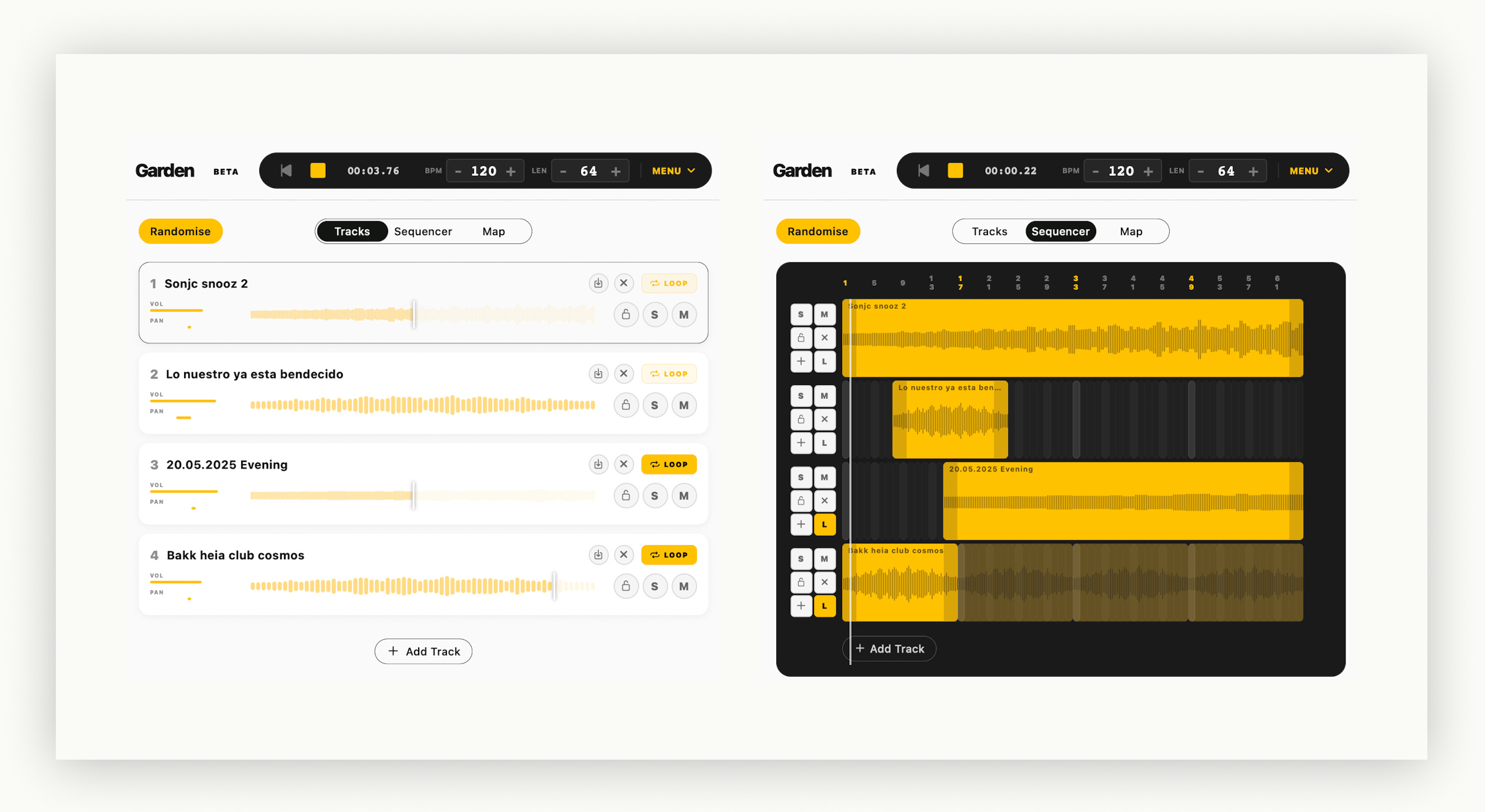
The Garden lets you layer existing AudioSpaces, either by hitting the Randomise button or picking manually from the thousands of recordings already created.
Use the Track view to loop, edit or filter the individual AudioSpaces.
Use the Sequencer view to compose your soundscape.
Mute, solo or lock tracks to keep them unchanged when you randomise the other AudioSpaces in the Garden.
Save a Garden to come back to it later and finally Publish to make it available to the rest of us.
Add (or ‘re-plant’) existing Gardens to engage with someone else’s creations and add your own ideas to them.
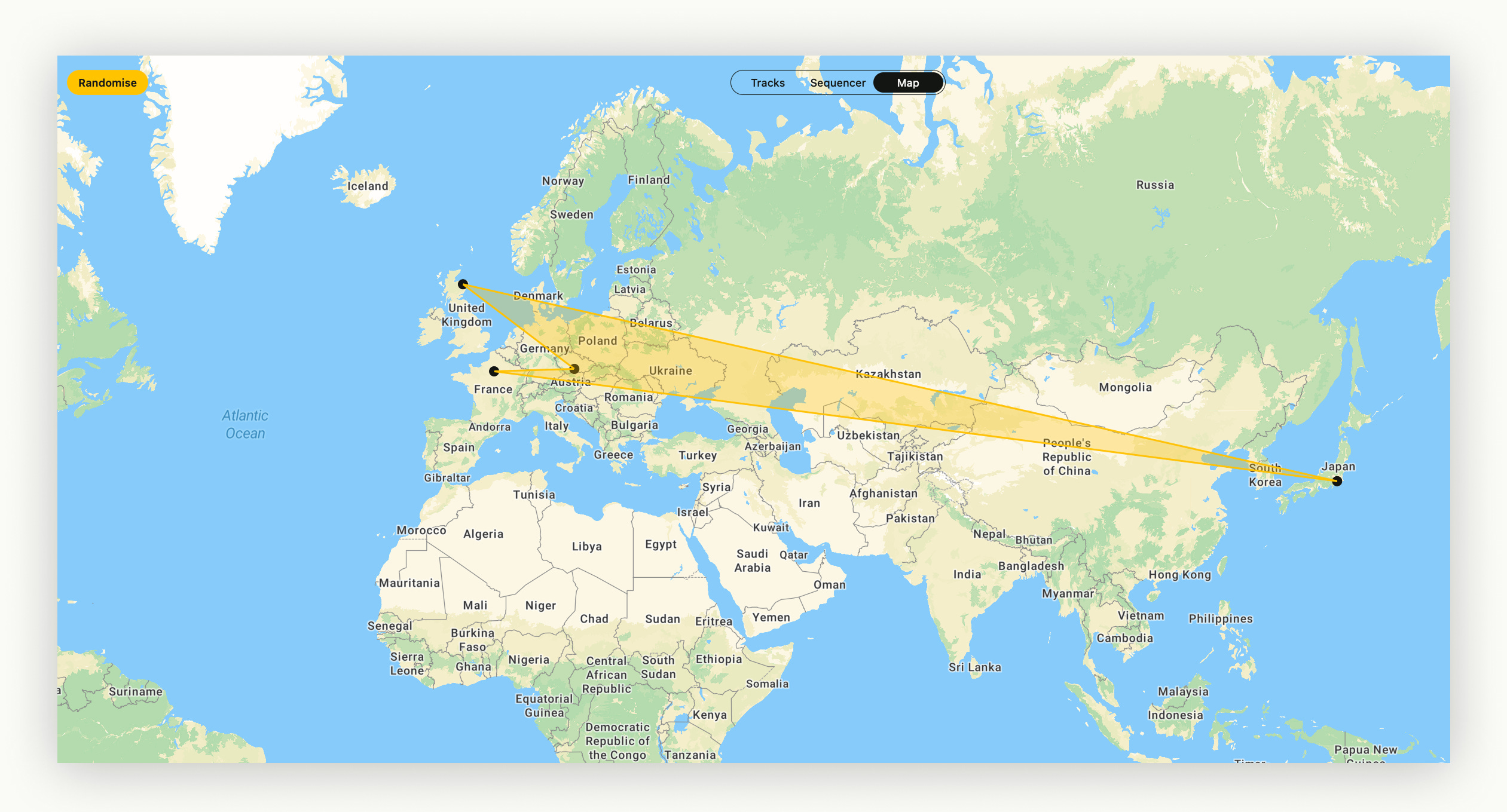
The Map view illustrates how your Garden connects sounds and memories from different places around the world. We can think of a Garden as this yellow region bounded by the AudioSpaces that make up the soundscape.
Bear in mind this is our first version of the tool, and things will probably change quite a bit as time goes on. We’ll keep you in the loop.
Space Station
Late last year we introduced the idea of incorporating broadcasts into our toolbox with Space Station. This has developed somewhat into a full-blown live radio function, which we’re happy to relaunch along with Garden. Here’s Oliver again:
First there were AudioSpaces, and we found a way to combine these into Gardens. Now we would like to introduce a way to curate radio-style shows to explore different themes with AudioSpaces, Gardens and narration.
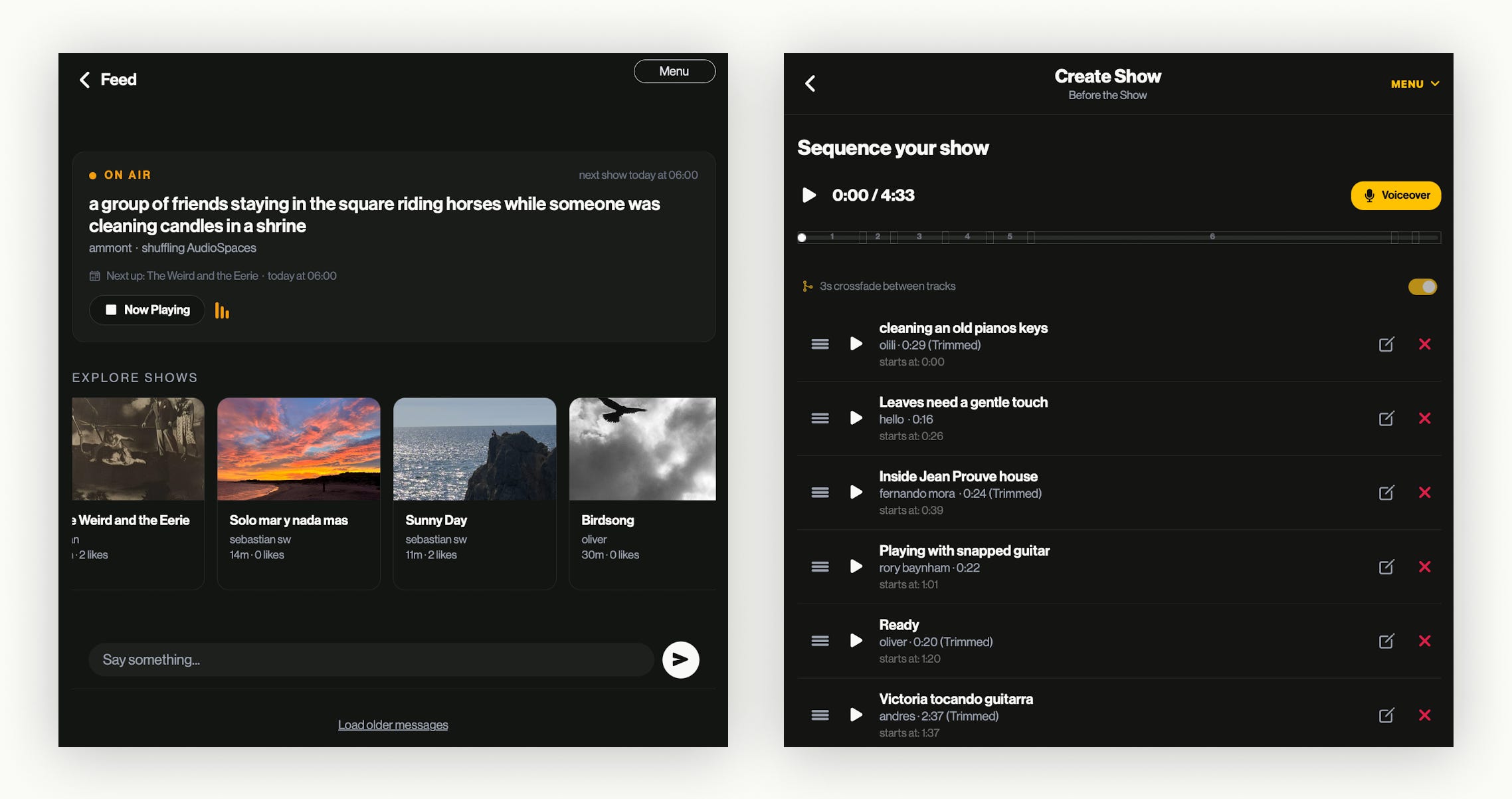
Check out the day’s Space Station schedule or explore the show archive. There’s also a chat in which you can respond to shows and AudioSpaces in the stream.
To give it a go:
Go to the Space Station page.
Select the AudioSpaces you would like to include.
Sequence the recordings and add your own voiceovers if you like.
Give the Show a title and a description, and you’re ready to Publish.
Just like with Garden, we’re still improving this, so would love to hear how you find the process of creating shows.
In that famous text, Schafer asks whether the soundscape of the world is “an indeterminate composition over which we have no control, or are we its composers and performers, responsible for giving it form and beauty?”.
I think it’s probably somewhere in the middle: the acoustic world is co-created and semi-autonomous.
If we consider (as I do) listening to be something we do – an active, productive intervention in the world – then surely it follows that even just paying attention to the sounds around us will always involve some degree of performance.
There’s always an interplay, in other words, between us, our ears and the acoustic environment. There’s a politics of perception going on, made all the more complicated when we stick a microphone in the middle. This is going to be the case whether we choose to recognise it or not. There isn’t really such thing as truly “passive” listening.
Listening in (with, through) the Garden and the Space Station is one way of taking responsibility – to borrow the phrase from Schafer – for the soundscape of the world’s form and beauty.
As I’m sure you will agree, it was lovely to hear directly from Oliver this month. If you say some nice things maybe he’ll come back! In the meantime, all of AudioSpaces is free and open for you to explore and exploit – let us know how you get on. Happy weekend :)