
Dear friends, welcome to the last AudioSpaces newsletter of 2025.
This year we’ve oscillated a few times between sudden spurts of activity and, admittedly, a few protracted lulls on our part. Every step of the way, though, the map continues to resonate more and more. To all our new contributors who joined this year, thanks for taking part in this expanding cartophonic project.
Before we do the obligatory roundup of our activities from this year, first let’s have a taste of our favourite contributions from the last couple months.
AudioSpace(s) of the month(s)
We’ve been thinking about how to best share these lovely sounds in a way that makes sense and is easy to access. The traditional list format we usually use is fine, but it’s also nice to try out something new over the festive season.
For this end-of-year edition (and who knows, maybe from now on) you can find November and December’s picks in two tidy Collections on our platform. Just tap the buttons below:
This time note that these are mostly picks from our Android users. Not a bias, I promise; we’re still in the process of fully combining the two archives. But the great thing about doing it this way is that we can keep adding to the Collections as we balance things out.
AudioSpaces in 2025
Android version and website
Clearly the most exciting thing of the year for us was launching AudioSpaces across platforms. This had been long in the works, and in July we finally unleashed our Android and Web versions. Your continued feedback on these is really appreciated.
Bit by bit we’re performing the great convergence between our iOS archive and that of the new versions. Soon this will include the final transformation of the iOS user interface, so our iPhone-using veterans can experience our latest design iterations.
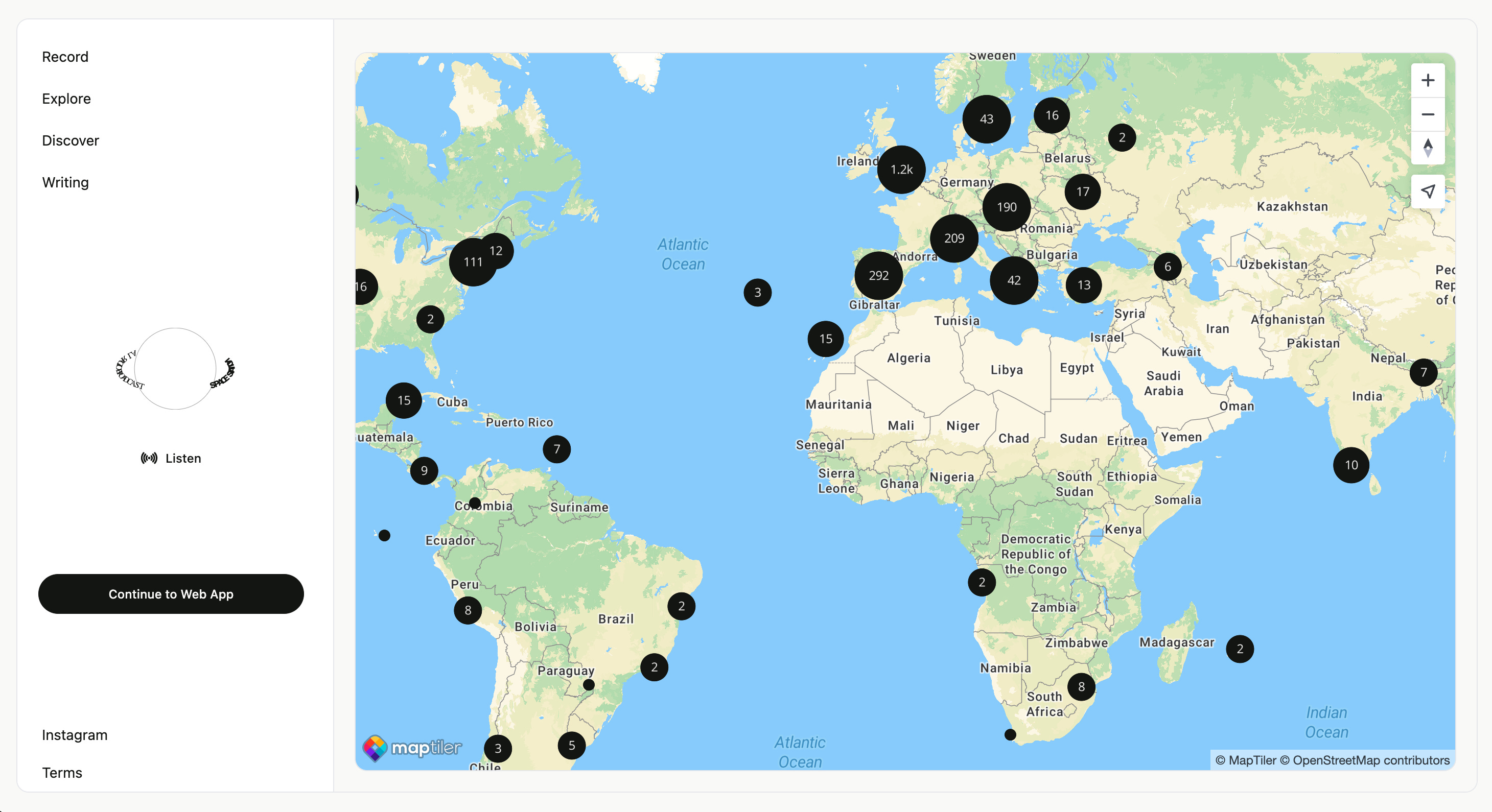
It’s also worth mentioning that the web app actually sits in our wider website. Oliver has being bolstering audio-spaces.com over the last few months to become our one-stop shop for everything to do with the project. You can now even preview the map without having to make an account first—though the full experience, which includes contributing sounds, of course still requires one.
Space Station
Alongside these platform developments, we’ve been experimenting with different kinds of playback—still part of our interest in listening, but in this case it’s listening to our devices rather than the world “out there”. We’re building tools to help us draw new connections between all the different audio found on the map, and eventually beyond.
In October we released Space Station, which at the moment works as a stream of AudioSpaces sounds put together collectively in monthly Collections. We invite you to add any amount of audio, old or new, to these Collections—and we’ll do the same. Then simply tap Listen, sit back and let a sonic montage wash over you as the Space Station floats around the map.
This coming year these newsletters will include reminders of the monthly broadcasts. Think of this as just the first step for Space Station, which will be our main outlet for collaborative curation and audio playback.
Prizes, collabs and conferences
The AudioSpaces map speaks for itself, but there are a few other things that happened this year which we were proud to be part of.
Big Idea prize
One of these was courtesy of our project integrante Sebastian, who won a prize with AudioSpaces at the University of Westminster Enterprise Network’s 2025 Big Idea awards.
As you can hear in his pitch, Seb entered the competition with the idea that AudioSpaces meets a growing public interest in audio journalling. This is partly because of the format’s capacity to tap into our personal and collective memories, while also being a reaction against the addictive and toxic tendencies of social media.
Of course, both of these themes run deep through our designs, and Seb’s presentation is a great reminder of that. It’s really confirming to us all that the judges of the award were convinced too.
We presented a paper in Seoul
Another event we were proud to participate in was the Hanyang University Music Research Centre’s Audible Futures conference in Seoul. We wrote a short paper based on four in-depth case studies with AudioSpaces contributors, exploring what patterns on the map might tell us about cultures of everyday listening, recording and sound more generally in the world today.
It’s strange to think that earlier this year we were munching seaweed flavoured crisps in Itaewon, reflecting on all the great conversations we had with sound researchers from across the world.
An extended abstract of our paper was published, alongside those of all the other fascinating presentations, in the conference proceedings. You can also read our abstract here:

Collaborations
There were two collaborations which we’re proud came to fruition this year.
Firstly, we finally connected with Mat Eric Hart from Sonic Tapestries, who blessed the map with some of his beautiful field recordings in Marseille. We also conducted a two-way interview which you can read on our respective Substacks.


Finally, last month we managed to get our single original article of the year published here on Substack thanks to Sam Newmarch. Reading this was a much-needed reminder about one of the key interests that drives AudioSpaces for us: paying attention, discovering and intervening in the world through sound.
Just like all of our collaborative activities this year, I feel that Sam’s essay replenished our juices and has set us up for another exciting year.
Noticing (and) Sound: Reflections on an Arctic Amble

After his last piece on archives, we get something a bit different from Sam Newmarch: a narrative of unexpected glaciers, croaking birch trees, wind-stricken microphones and literary realism.
Next steps
All in all, I think we’ve done a lot this year! And that very much includes all of you. But what direction do we want to take things in 2026?
The same and more
The key thing for us is to keep the map open, ticking along and accessible for anyone who wants to take part. This first and foremost means that engaging with the map will always be as easy, open and free as it was from day one. We will carry on making our infrastructure smoother, more intuitive and more inclusive, while sticking to our values.
But we also started this project to have fun. The coming year we’ll be rolling out a bunch of new features for playing with your ears, with your mics, and for stretching out and generally bouncing around with sound. This includes, but is by no means limited to, expanding Space Station.
New directions
There are some other exciting directions we will take this year which we’ll let you know more about as and when. This includes, firstly, working with specific communities who can find real use in location-based audio, sound maps and all the rest. Alongside this, we’ll also build on our serious reflections on cultures of listening, digital media technology and space.
This might all sound a bit mysterious, but soon come the details. If you’re curious or (even better) want to get involved, then the easiest thing to do is subscribe to this newsletter and (also better) share it to anyone you know.
In a panel discussion at a recent even in Bucharest, the chair commented that Romania doesn’t seem to have a “culture of sound”. What he meant in this context was that the profession of sound engineering, and all the importance of the sonic and the acoustic, is still generally overlooked in his nation’s music and arts sector.
This might be the case, but in response to this comment one of the panellists, legendary sound scholar Holger Schulz, brought an insightful perspective to the idea of having or not having a “sound culture”:
Just because [a sound culture] is not articulated and not explicitly addressed as such […] it’s not necessarily that it doesn’t exist. I would very much say that every culture, every nation, every environment has its sound culture—but it can of course always be more developed, always be more explicit and always be more reflected.
That last remark speaks exactly to what I feel we’re doing with AudioSpaces: inviting anyone interested to reflect, develop and make explicit “cultures of sound” of all kinds—from those of individual listeners from any background, to those of communities, organisations, causes, places, locales and everything in between.
This is admittedly quite ambitious, and our final priority for this year is to find the resources (financial and technical) with which we can really dedicate our time to making it all possible.
In other words, 2026 is the year we secure AudioSpaces as a project that’s still completely open-ended but also an exceedingly useful and, crucially, sustainable operation. Sounds pretty large.
Happy new year wherever you are x x